Geography, client categories and why many brands remain anonymous
When it comes to fragrance development and production, one of the most frequently asked questions is: “What kind of customers do you have?”
The most honest answer is: far more varied than you might imagine.
And above all, from many more markets than people think.
In BOLD’s case, about 90% of projects do not originate in Italy.
Not because the Italian market isn’t interesting, but because our model, an End-to-End Manufacturing Platform Made in Italy, is especially sought after by international brands and entrepreneurs.
A truly global market
In recent years, the geography of perfumery projects has changed radically.
Today, projects come from all major international markets. Primarily from:
-
Europe
-
GCC (Middle East)
-
United States
-
Latin America (LATAM)
-
Asia
-
Oceania
This does not mean simply shipping products to different countries. It means working with:
-
different distribution models
-
different olfactory sensitivities
-
different price levels
-
very different brand structures.
Each market has specific expectations about:
-
fragrance intensity
-
storytelling
-
value perception.
And it is precisely here that Made in Italy remains an extraordinary lever.
The value of Made in Italy in contemporary perfumery
For many international brands, manufacturing in Italy is not just an industrial choice. It is a positioning decision.
Made in Italy in cosmetics and perfumery represents:
-
technical expertise
-
quality of raw materials
-
manufacturing tradition
-
supply chain reliability
But above all it represents credibility in the global market. For many international brands, being able to declare that a product is developed and produced in Italy means immediately entering a higher perception tier.
It is not only a question of real quality. It is also a question of perceived quality
The categories of clients we work with
Another often misunderstood aspect concerns the type of clients. Many imagine there is only one type of project. In reality, perfumery projects today come from very different categories.
Among the most frequent:
Niche perfumery brands
Independent founders who want to build a distinctive olfactory signature and very precise positioning.
Prestige brands
Brands with selective distribution and a strong focus on design, storytelling and fragrance quality.
Masstige brands
Projects that aim to bring high quality at an accessible price, with a strong focus on value for money.
Mass-market brands
Lines designed for large volumes, where the main challenge is balancing industrial cost, product perception and stock turnover.
Each category requires a different approach. There is no one-size-fits-all model.
Why many brands remain anonymous
One of the questions we get asked most often is: “Why don’t you publish the names of the brands you work with?”
The answer is simple: in most cases we are bound by non-disclosure agreements (NDAs). In the perfume industry, this is very common.
The reasons are several:
-
protecting launch strategies
-
confidentiality of formulas
-
protecting production chains
-
protecting brand positioning
For this reason, many projects remain publicly anonymous, even when they have a significant market presence.
This is not a limitation. It is part of the very nature of development work. Whoever works as an industrial and strategic partner often works behind the scenes.
The true common denominator
If we look at all projects, regardless of geographical origin or market category, a common element emerges. Brands aren't just looking for a manufacturer. They're looking for someone to help them build a coherent project.
Because today a perfume is not simply:
-
a formula
-
a bottle
-
packaging
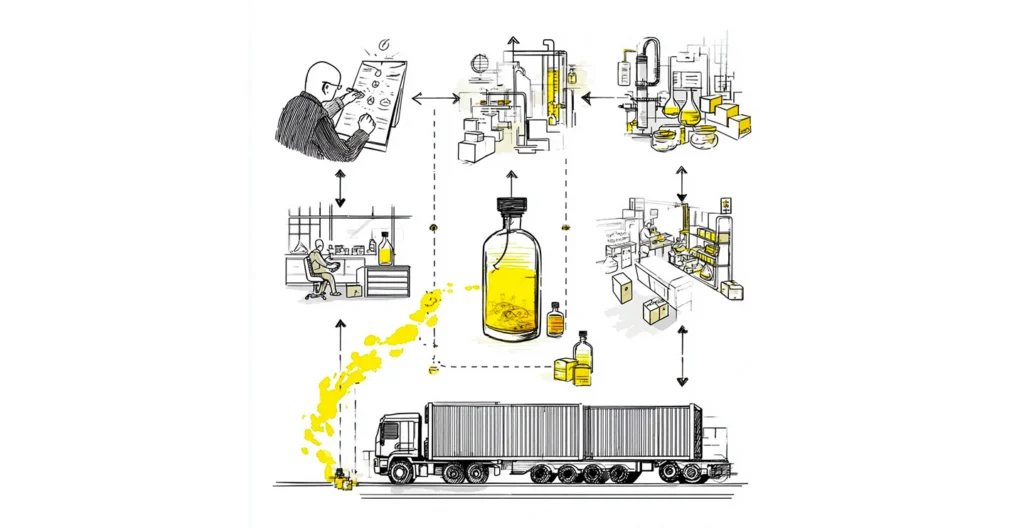
It is a system composed of:
-
positioning
-
price
-
experience
-
supply chain
-
distribution
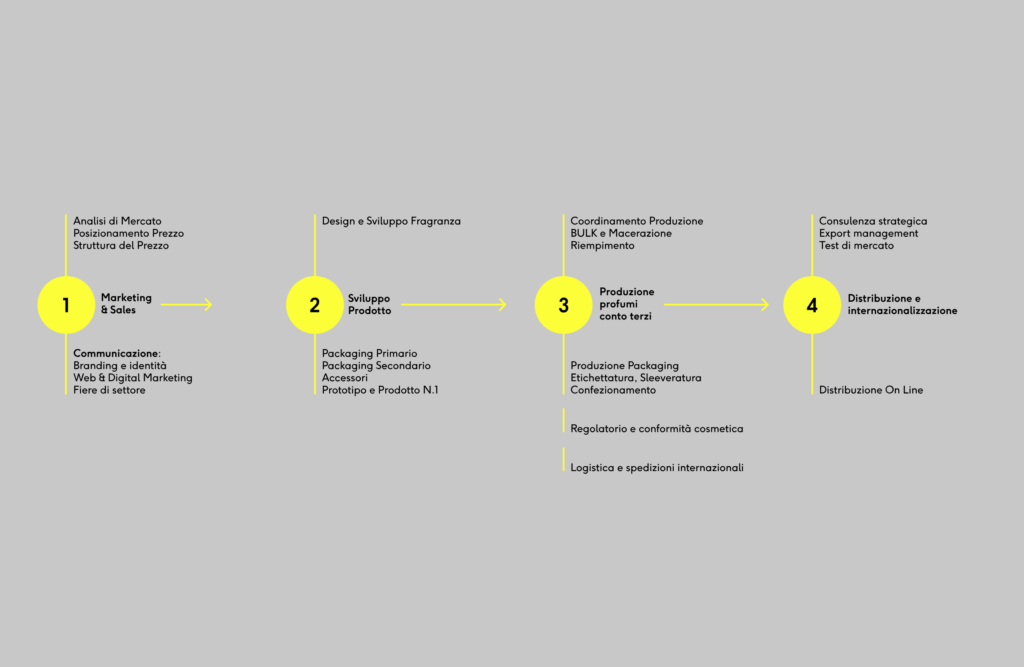
This is exactly where our End-to-End Manufacturing Platform becomes central.
Conclusion
Contemporary perfumery is increasingly global. Projects are conceived on one continent, developed on another, and sold in many different markets.
In this scenario, the value is not only in production. It lies in the ability to turn an idea into a coherent industrial and commercial system. And this is precisely why many international brands continue to look for partners in Italy.
Not just to produce a perfume. But to build a project that can truly succeed in the market.