What really happens, from brief to finished product
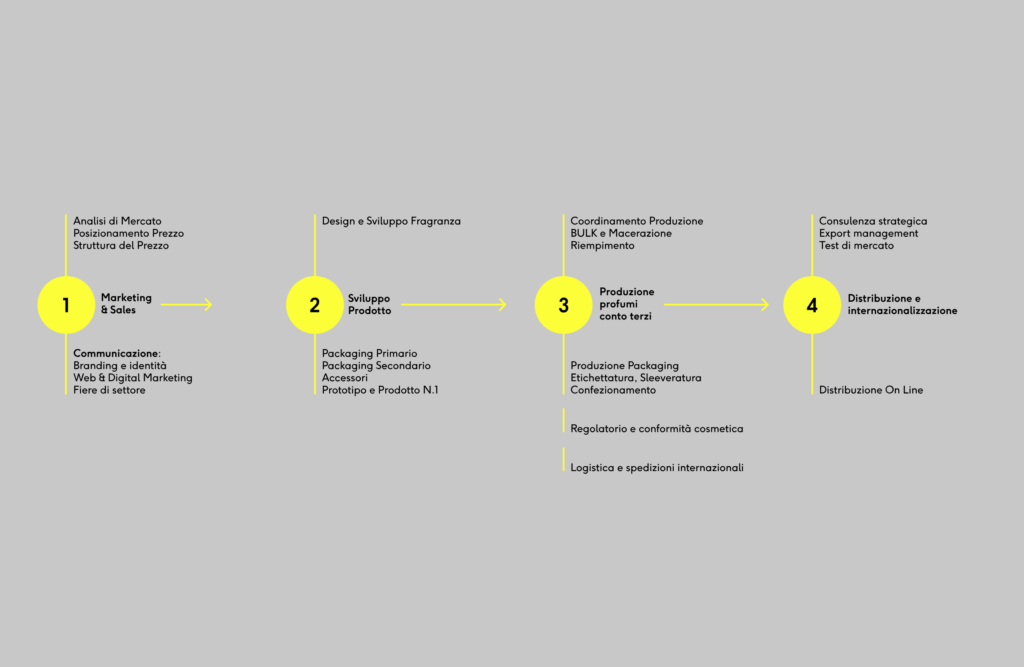
When people talk about developing a perfume, the process is often described in a simplified way:
idea → fragrance → packaging → production → sale.
In reality, a perfumery project does not work that way.
Or rather: when it is managed this way, it rarely really works.
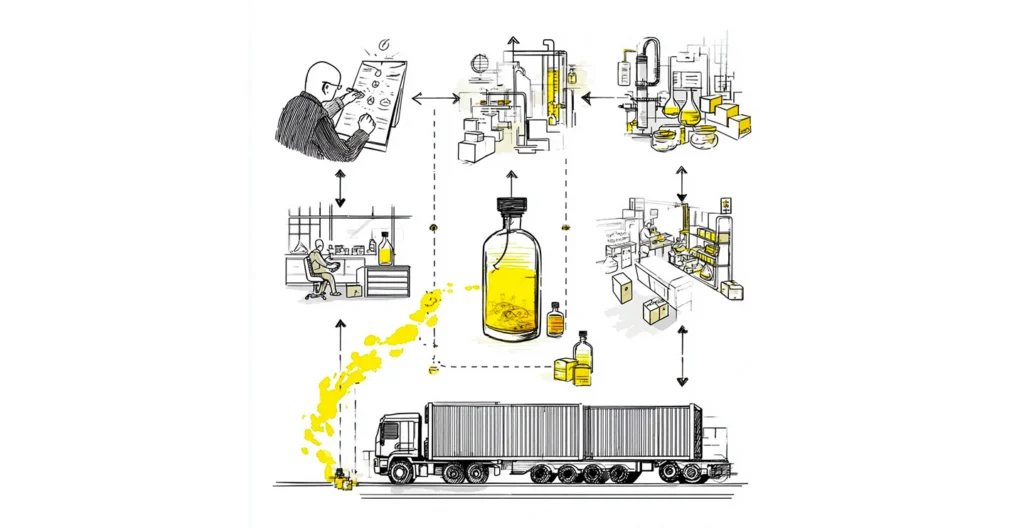
A sound project is not a linear sequence of activities, but a system of interconnected decisions.
Understanding the real stages means understanding where value is created and where, more often, problems arise.
1. Clarifying the context (even before the brief)
The first stage is not creative. It is contextual.
Before talking about fragrance or design, it is necessary to clarify some basic elements:
-
who the product is for
-
where it will be sold
-
at what price it will have to be credible
-
with what initial and projected volumes
This stage is often skipped or treated superficially. It is a mistake.
If these parameters are not clear from the start, every later stage will be forced to adapt, with costs, compromises and rethinking.
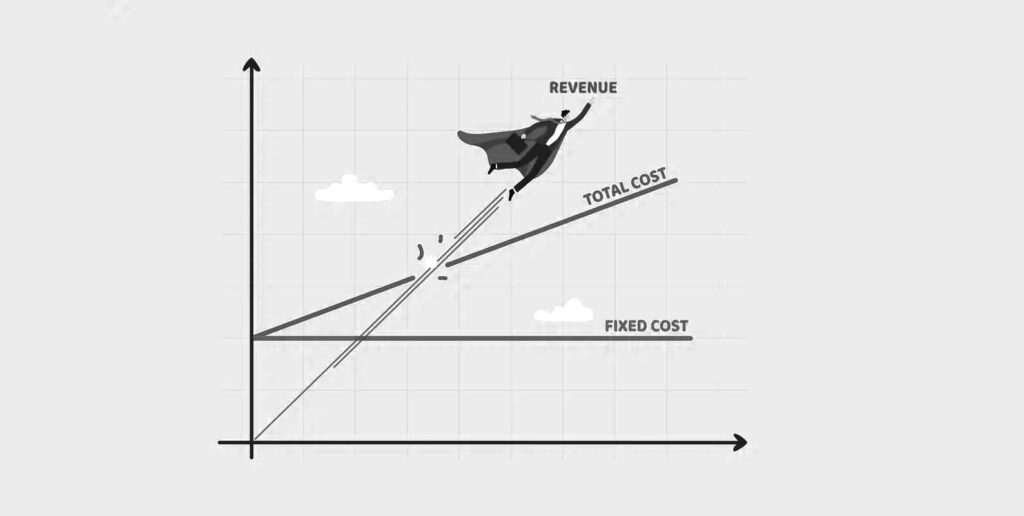
2. Defining the economic scope
Immediately after context comes a crucial and often underestimated stage: the economic scope of the project.
We are not talking about “final costs” yet, but about:
-
sustainable cost range
-
margin targets
-
production limits
-
industrial constraints
This stage prevents a very common pattern: beautiful projects that, once on paper, do not stand up economically.
3. Construction of the brief (the real one)
Only at this point does it make sense to talk about the brief.
An effective brief is not an inspirational document. It is an operational tool.
A good brief contains:
-
clear indications of positioning
-
olfactory references (not ingredient lists)
-
realistic target
-
explicit constraints
When the brief is vague, creativity becomes inefficient. When it is clear, creativity becomes precise.
4. Olfactory development and creative directions
This is the best-known stage, but not always the best understood.
Fragrance development is not about “choosing the most beautiful scent”. It is about exploring directions consistent with the project.
Creative directions are used to:
-
test the brand’s identity
-
understand how far it can go
-
identify what does not work
Discarding is part of the process. In fact, it is one of the most important parts.
5. Technical validation of the fragrance
A chosen fragrance is not yet a manufacturable fragrance.
This is where aspects that are often invisible come into play:
-
stability
-
compatibility with packaging
-
regulatory compliance
-
repeatability
Skipping or squeezing this stage means pushing problems further down the line, where they cost much more.
6. Packaging engineering (not just design)
Packaging is not a “later” stage. It is a structural stage.
This stage defines:
-
real components
-
weights
-
materials
-
availability
-
minimum order quantities
Packaging must be consistent with:
-
price
-
channel
-
positioning
Inconsistent packaging does not ruin a project straight away. It makes it fragile over time.
7. Industrialization of the project
Here the project moves from theory to reality.
This stage includes:
-
selection of suppliers
-
production planning
-
real lead times
-
actual costs
This is when many assumptions are confirmed or disproved.
A well-built project gets here with few surprises. A poorly built one starts to change shape.
8. Production, filling and packing
This is the most visible stage, but not where the key decisions are made.
Here, what was decided earlier gets executed:
-
fragrance production
-
filling
-
packing
When everything has been designed correctly, this stage runs smoothly. When it has not, delays, rework and unexpected costs appear.
9. Getting ready for launch and reorder
A project does not end with the first batch.
One of the most important questions is: what happens next?
-
is the reorder simpler or more complex?
-
do costs really come down?
-
does the supply chain hold up?
Thinking only about the launch means designing halfway.
Conclusion
A perfumery project is not a sequence of creative steps. It is a system of decisions that must remain consistent over time.
Those who understand the real stages:
-
reduce mistakes
-
save time
-
build stronger projects
Those who ignore them often discover problems when it is too late.
Insight Strategy note
This article is not meant to “teach” perfumery. It is meant to make it more readable.
Because the projects that really work are not the most inspired ones, but the ones built with the greatest awareness.